
Power of Innovation 2025-2026: DATA AND AI

Harnessing data, digital and AI for public good
Edinburgh is the birthplace of AI in Europe, with 60+ years of expert talent, advanced computing and crosssector partnerships. The Fast Forward conference, ‘Data and AI: beyond the hype’, hosted by Edinburgh Innovations (EI), asked where AI delivers verifiable benefit and which use cases justify costs.
Dr Andrea Taylor, EI’s CEO, said: “We talk so much about AI, but which AI are we talking about? We need to remember that AI is a set of tools and focus on making sure they are both ethical and fit for purpose. We can do this by bringing together those with the deep subject knowledge to create the technologies, and those with the skills and resources to adapt and deploy them for social and economic benefit.”
Momentum is clear, with 59% of new student startups driven by the data and AI mission; 35% of industrial awards; 28% of investment and 27% of consultancy aligned to this mission.
59%
of new student startups were aligned with the data and AI mission
35%
of industrial awards aligned with the data and AI mission
28%
of investment into University-associated companies went to those aligned with the data and AI mission
Recovering GPU capacity
Edinburgh graduates’ startup Expanse, supported by Edinburgh Innovations from its first funding, has raised $5.3m in seed investment. Its software predicts AI workload needs before they run, recovering wasted GPU capacity. The technology could save millions in costs and carbon emissions, helping organisations achieve more from existing hardware instead of building new data centres.
Saving GP time
Edinburgh finance graduate Robert van Biljon taught himself to code with ChatGPT and, supported by Edinburgh Innovations, pivoted his student notetaking idea into Nora AI, a medical scribe. Saving doctors up to three hours daily and growing 23% monthly, it was acquired by health tech firm Healthbridge within two years.
Quantum optimisation
Startup Qinara is improving AI reliability through hybrid classicalquantum optimisation. Its CirQ circuit optimiser boosts model accuracy by up to 40% while cutting computational costs by 70%, helping prevent costly errors and reduce environmental impact across biomedicine, cybersecurity and finance, and bringing practical quantum technology to industry.
Screening for TB in cattle
AI for the Eye, founded by Michaela Thorne, is a non-invasive diagnostic platform combining retinal imaging and AI to screen for bovine tuberculosis in cattle. A PhD student at the Royal (Dick) School of Veterinary Studies, Ms Thorne developed the idea to tackle this devastating disease after seeing this problem as a veterinary surgeon.
Delivering economic value
An independent report by London Economics showed the UK’s ARCHER2 supercomputer, based at EPCC, delivers an economic return of £8.30 for every £1 spent. By powering cutting-edge R&D in drug discovery and climate modelling, it fosters new spinouts, patents and products, supporting the training of over 800 computational experts; advancing treatments for heart disease, tackling antibiotic resistance and accelerating the development of cleaner aircraft.
Turbocharging quantum
A £20m UK Government investment in the University of Edinburgh’s Quantum Software Lab will launch QATCH, a four-year programme with the National Quantum Computing Centre. By linking researchers, hardware vendors and industry, it will turn quantum software into trusted applications across healthcare, energy, finance and cybersecurity, while building industry talent and driving growth.
Working with universities means you have the time to explore problems in a deep way, which I really value. Universities are trying to enhance knowledge rather than sell something, which brings clarity and transparency. The technology is moving so fast we need to partner with the right partner at the right time, and universities can help industry solve the problems of tomorrow.”

Dr Shirley Cavin
Head of Emerging Capabilities (Data & AI) at Leidos UK & Europe
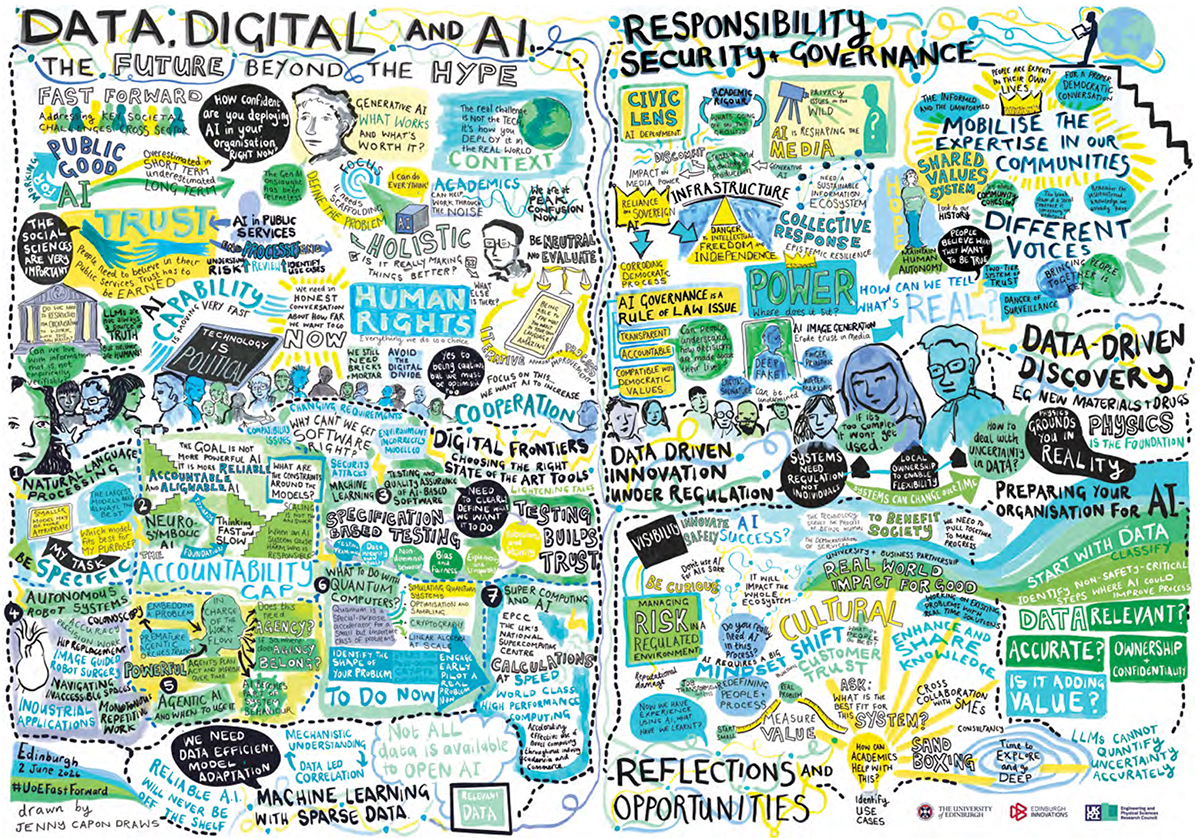
Artist Jenny Capon captured conversations at Edinburgh Innovations’ Fast Forward conference ‘Data and AI: beyond the hype’ in June in this graphic recording of the day.
Turning data-driven research into child protection
Childlight, a global child safety institute hosted at the University of Edinburgh, shows how commercialisation can turn research into protection for children. Its Into the Light index and Searchlight reports gather siloed data on child sexual exploitation and abuse (CSEA), providing evidence that frontline partners can act on to prevent harm.
Edinburgh Innovations is supporting Childlight’s evolution towards consultancy, expert advice and indepth collaborations. By helping to secure funding, navigate relationships, identify partners and provide contracts, the team enables the institute to work quickly and efficiently with organisations unfamiliar with partnering with researchers.
The results are tangible. Childlight’s data informed the Expert Engagement Group on AI and Child Safety in India, strengthening digital safety legislation. Professor Debi Fry’s expert input to the UK Government’s ‘Growing Up in an Online World’ consultation shaped online safety policy, including the forthcoming under-16 social media ban. A collaboration with Kerala Police, running since 2023, enabled data-driven enforcement, including India’s largest child protection operation in February 2026, which led to 26 arrests and the seizure of 431 devices.
Childlight is inviting government ministries, police forces, healthcare organisations, financial services institutions and NGOs to collaborate, share data and turn evidence into action to prevent abuse.
Robotics adoption
Created in partnership with Heriot- PARTNERSHIP Watt University and the University of Edinburgh, The National Robotarium is accelerating UK robotics adoption. Its 140-strong team forged 20 new partnerships this year, engaged over 10,000 people and secured £1m+ in government funding.
Building trust in AI for finance
Fintech startup Aveni raised £12m in a funding round led by PXN Ventures, with backing from existing investors including Lloyds Banking Group, Nationwide and Scottish Enterprise. The AI specialist will use the investment to develop its Unified Assurance Platform and launch Agent Assure and Agent Approve, tools that assess the conduct risk of AI agents dealing with consumers in financial services. Founded in 2018 with support from Edinburgh Innovations and seed funding from Old College Capital, Aveni is built on research by Professor Lexi Birch of the School of Informatics.
Gamification for more inclusive democracy
Otter Intelligence, co-invented by Dr Agnessa Spanellis and Dr Adam Chalmers, uses gamification to make public consultations more democratic and inclusive. With support from Edinburgh Innovations (EI) through contracts and relationship management, it has changed how two National Park Authorities consult their communities.
For the Lake District National Park Authority, a game developed for the five-year Partnership Plan reached almost 200 pupils aged 12–14, giving the partnership young people’s views that conventional consultation would not have captured. Their input helped prioritise policies on nature’s recovery and shaped the Plan’s draft and revisions.
At the Cairngorms National Park Authority, gameplay by a mixed-age group informed priorities including rural development, housing and community wealth building. Because the game offered an innovative approach, the Authority was able to attract a more diverse audience than traditional events draw.
An AI-based tool analyses recorded conversations, giving policymakers reliable, in-depth evidence. With EI’s help, the researchers are developing AI ‘players’ for online games and a licensing model so other local authorities and businesses running public consultations can adopt Otter Intelligence.
Embracing responsible AI in music software
Generative AI’s ability to emulate artists’ work threatens the livelihoods of musicians, composers and producers. DataMind Audio is changing that.
The music software company launched in 2022 with initial Creative Informatics funding from the University of Edinburgh. It was founded by Ben Cantil, a student of Dr Martin Parker’s MSc Sound Design programme and Catherine Stewart, now CEO. Four Edinburgh graduates continue to work as consultants.
Supported by Edinburgh Innovations, which manages contracts and protects intellectual property, the partnership with Dr Parker produced “Artist Brains”: neural network plugins capturing a producer’s sonic identity. Producers endorse their own Artist Brain and earn royalties on sales, creating an ethical generative AI marketplace. Dr Parker’s research also enables emerging artists with few tracks to be represented.
Dr Parker’s BRAID Fellowship funded by the Arts & Humanities Research Council continues the collaboration. DataMind Audio has completed a proof of concept with a large telecoms company, is trusted by global companies including Epic Games and Hans Zimmer’s studios, and is now raising its first investment round.
AI Acceleration
The University of Edinburgh’s AI Accelerator turns promising ideas into commercial impact. Its ninth cohort of 12 companies is tackling challenges in health, sustainable fashion and cybersecurity, while alumni such as Space Intelligence have raised seed and Series A investment and worked with major clients including Shell and Apple.
Scaling responsible AI at NatWest Group
A University partnership with NatWest Group has scaled AI ethics expertise from small-scale pilots to a learning pathway for 60,000 staff. Adapting Masters level research from the Edinburgh Futures Institute into practical training, the collaboration equips colleagues to apply fairness, transparency and accountability in everyday banking decisions, showing how academic insight becomes organisation-wide capability.
